Posts

Mites and darkness (9 pics)

Image
It has not been the best year for succulent growers in my area. It has not been cold in winter, it has not been hot in summer. It has been just dark and gloomy all year. When sunny days are rare it means there is not much watering. If waterings are rare there's not much growing. Except for spider mites. Those grow nicely when it's dry. At some point I moved Delospermas outside (those are the most tasty) which improved the situation. But I still find mites on my plants occasionally (and kill them on site with my bare hands) and the damage is visible: nibbled leaves, weakened plants. I hope next year is sunnier and better all in all and the plants can recover. My favorite and oh so perfect Frithias I was so proud of look like this now. It takes them so long to grow those leaves. Much time will pass until they've outgrown the bite marks. Assumed the attack is over. And yes, I've been spraying a lot which has contributed to the damage on some plants I think. But Aloinopsis ...
Avonia quinaria (4 pics)

Image
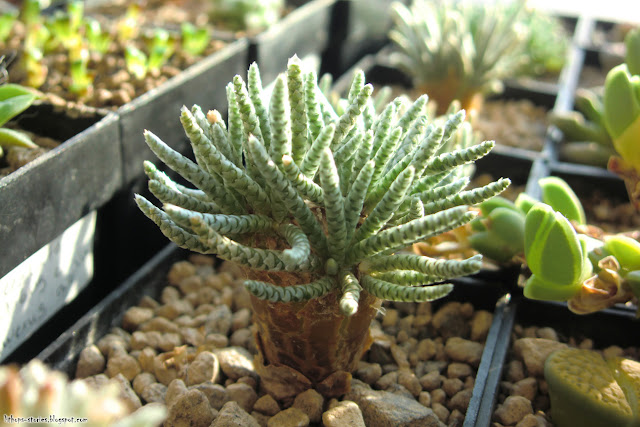
I feel like I need to read up on Avonia's (as well as Anacampseros) yearly growing cycle again. It seems they are in an active growth phase now, having flowered for the last time in October. I thought they are supposed to be resting in winter. Maybe they will. It's not winter yet. Avonia quinaria plants are not very difficult to grow on the windowsill (in pure pumice) and they will flower for you, too. The main cause of death is overwatering. I made a mistake once - I thought the thick root will increase in size if I buried it. The only thing that came out of it was a dead plant, rotten from the inside, and a resolve not to do this ever again. You see, the only clear way of telling whether an Avonia quinaria needs water, at least for me, is to squeeze the raised root a bit. Sure if the plant needs water the branches might drop a little. But depending on the time of the year those branches might be too short to drop visibly. So from now on they all will grow raised and looking l...

Argyroderma crateriforme flower (6 pics)

Image
I'm so happy and excited that this plant has decided to flower! :) It is gorgeous and a bit crazy. Does the name crateriforme come from the inside of the flower? I have never watched an Argyroderma flower bud develop and I found it very curious how different it is from the usual mesemb flowers I've had so far. Okay, maybe it's not that different but it definitely looks different to me.  The mesemb flower buds I've seen on my windowsill so far were elongated with tips of the petals showing at some point before the flower opens. The Argyroderma bud started as something round and flat, almost looking more like a seed pod than flower bud.  It grew larger and when the sepals parted a bit you could see that the petals are actually curved inwards, folded with their tips toward the "crater".  It stayed like this for a while and then yesterday suddenly it "erupted" and the petals darted out. It stayed like this until today. It was sunny today and the flower f...

Adromuschus clons (5 pics)

Image
For a while now I have been wondering about price development for succulent plants these days. Prices are skyrocketing for no apparent reason. It's not like the plants have gotten more rare or have grown indestructible. Plants are not an investment. They die. Quite suddenly, too. No regular size plant that's not even old, even if it is extremely rare, should cost more that 20€ and seeds more than 5€. Why would you pay more? Some prices are ridiculous! Out of curiosity I've recently checked Ebay for Adromischus and saw a small plant that was visually nothing special going for 4500€. Why? And especially for Adromischus. It multiplies easily from a leaf, no effort required from the grower. Fellow growers, let's share our passion, not kill it by making plants and seeds unaffordable. So, apparently, I am not buying new plants anytime soon. More time to enjoy those I have, am I right? ;) In September 2013 I got one  Adromischus marianae v. herrei (green form) and now I have ...

Breaking news! Argyroderma crateriforme growing a flower

Image
I can not believe this is happening! This senior citizen has caused me some worry in the past. When I first got it I worried about its poor roots . With time I learned it is actually normal and okay for these plants to economize on root development. Then, I worried about rotting . With such a beautiful beard of old leaf layers (how old might it be, I wonder) it might be rotting somewhere inside if drops of water linger too long. Having it grow in pure pumice and in the very top layer of it with all the beard on top to dry in the sun if necessary as well as extremely reduced waterings has reduced my fears as well. I worried it would abandon one of the heads , at some point, but it didn't. And so I thought keeping it alive was an achievement on its own. I never thought it would actually flower one day! I know it might be a bit too early and it might abort the bud but I'm too excited not to share this news :)

Some more flowers (3 pics)

Image
So it looks like this fall has brought more flowers than expected. Quite some Lithops and Conophytums have been flowering and I can see three more buds growing. I guess, this flowering season was not worse than usual after all even though the weather was not suggesting that.  Aren't these Lithops dorotheae flowers just the perfect little suns? Glad I could catch them in the evening this weekend. A big surprise is this Faucaria tuberculosa bud. Really, this plants has been nibbled on by mites and overall neglected and it has never flowered for me before - but here it is, a flower bud. Thank you, little planty.

Transplanting for those who live dangerously (4 pics)

Image
Okay, what I'm about to describe below is not the correct way of transplanting, in fact it's very risky and I would never do it with lithops and other mesembs because they rot easily. Yesterday however I was facing a challenge of transplanting over 60 Anacampseros seedlings (An. retusa fa. rubra, An44) from the 5cm container they were growing in. Basically it looked like this: My goal was to give them more room to grow but at the same time not to use more than 4 new 5cm pots. Also, I wanted to do it quickly. Anacampseros are easy and don't rot when young (rotting sometimes happens to adult plants with thick roots) and I have way too many of them to worry. The method is simple: fill up the new container with dry pumice, then water the top layer (really just as much as necessary, don't make the whole thing wet), poke holes into it and stick in the plants.  This way you can fit up to 25 plants all neatly into one 5cm square pot quickly and with little effort. Remember, ...

The new Anacampseros free seed list! (2 pics)

Image
Hi guys! I finally found time to compile the Anacampseros seed list. If you are fascinated by these plants as much as I am make sure to check it out here  or to the right under "new!" Also, this is my 600th post. Congratulations to me :D

Transplanting in general (7 pics)

Image
I've been doing some transplanting. And there is more to be done because I really want to sow again very soon, all the seed rests that are probably not viable anymore, some of my own seeds (Avonia!), and some conophytum seeds I bought this year. So this is how it goes.  Step 1. Squeeze the container from all sides. This is why we use plastic and not clay ;) Step 2. Pull out the plants. If they don't come out easily, stop pulling and squeeze the pot again. Step 3. Now fill a pot with fresh dry pumice, up to the top. Step 3.1. Examine your plants for bugs and remove all old soil from the roots. It's ok to pull off some roots as long as the main root is intact. Don't be squeamish. I usually rip off some of the main root as well if it's too long. If you are transplanting from dry soil into dry soil the plants won't mind (roots inactive). Step 4. Use a stick to plant the seedlings into the container by dragging them down by the root (in case of adult plants you will ...

Flowering season of sorts (7 pics)

Image
Winter is coming. It's dark when I go to work, it's dark when I come back home. Oh and the sun is rarely shining on weekends. That's a bit annoying after the rainy summer we've had here. Still, some lithops and conos have been flowering and there are currently 4 more lithops buds growing. That's not bad considering the conditions they had to endure this year. Strangely (or not?) the lithops that grew flowers this year are all the usual suspects, the plants they are flowering for me every year, L. bromfieldii 'Sulphurea', L. fulviceps 'Aurea' and L. dorotheae. If not for them I would not have any flowers at all. I'd recommend north-earopean growers to have those in their collection if they want to see flowers. L. bromfieldii v. insularis 'Sulphurea' C362 L. fulviceps v. fulviceps 'Aurea' C363  L. dorotheae C300 I kept last year's seed capsule to see if the plant will grow flowers out of the same head every year. This is what it...

Avonias lifting branches: a theory (3 pics)

Image
In the latest post I casually mentioned my observations regarding the behavior of Avonia albissima branches with ripe seed pots. I find it quite interesting. Apparently, the branches that otherwise lie flat on the ground at all times suddenly lift when the seed pod has ripe seeds in it. I've been watching the flowering Avonias closely since then and it happens regardless of whether they've been watered or not. Recently a couple of my Avonia quinaria plants have been flowering, too. They are normally not self fertile but it still happens from time to time that a seed pod develops. This time it happened again and look at that! The branch with a ripe seed capsule goes way up while the other one lies on the ground.  I've developed a theory as for why Avonias are doing that. Completely unscientific of course!! :D You know, ripe Avonia seed pods workings are the opposite of Mesembs. The seed pods close up when they are wet and open when they are dry. Not only lifting the pod up t...